Testing Integration Routes as Software Design
by Joel Holder
Integration code is often described as glue, but that phrase undersells the work. A route that receives a payload, validates it, transforms it, calls another service, publishes a message, and records an outcome is application logic. It has behavior. It has failure modes. It deserves tests that are as deliberate as the tests around any domain service.
The philosophy is simple: design integration routes as explicit boundaries, then test those boundaries before the real infrastructure becomes the only way to learn whether the design works. A good integration test does not prove that the whole distributed system is healthy. It proves that this route honors its contract when collaborators behave in known ways.
This article uses Apache Camel, Spring, and JUnit examples, but the same ideas apply to message brokers, HTTP APIs, ETL jobs, serverless workflows, and event-driven services in general.
Treat integration routes as designed boundaries
An integration route is a boundary between systems. It usually answers questions like:
- What input shape do we accept?
- What output shape do we produce?
- Which headers, metadata, or correlation IDs must be preserved?
- Which downstream endpoint receives the result?
- What happens when a dependency times out, rejects the payload, or returns malformed data?
Those questions are testable. They also make the design sharper. If a route cannot be tested without booting a queue broker, a database, three vendor APIs, and a scheduler, the route probably has too much environmental knowledge baked into it.
Design for testability before writing the route
Engineers who already practice test-driven development know the loop: specify behavior, implement the minimum code to satisfy it, refactor while protected by tests. Integration work benefits from the same discipline, but the unit under test is often a pipeline rather than a method.
For routes, the design-for-testability version of that loop looks like this:
- Define the contract: input, output, headers, side effects, and error behavior.
- Keep transformation logic in small services or processors that can be tested without infrastructure.
- Inject endpoints, clients, and configuration instead of hard-coding them.
- Build route tests that replace real endpoints with mocks, stubs, or in-memory components.
- Run those tests in CI so route behavior is protected as dependencies change.
The goal is not to mock everything forever. The goal is to put fast, deterministic tests around route behavior so the slower environment tests can focus on wiring, credentials, schema drift, and deployment reality.
Separate orchestration from transformation
Routes should orchestrate. They should decide where messages come from, what processors run, where the result goes, and how errors are handled. They should not hide complex parsing, validation, enrichment, or business rules directly inside route definitions.
A small processor or service is easy to test in isolation:
XmlProcessingService xmlProcessingService =
    new XmlProcessingService();

ProcessingResult result =
    xmlProcessingService.processTransaction(sampleXml);

assertTrue(result.isAccepted());
assertEquals("SUCCESS", result.status());
That style of test gives precise feedback when the transformation is wrong. The route test can then focus on whether the processor is called at the right point and whether the resulting exchange is sent to the correct endpoint.
Use dependency injection to control lifecycles
Object lifecycle matters in integration tests because routes often hold references to processors, clients, connection factories, serializers, and retry policies. If those objects are created implicitly, the test has fewer ways to replace them.
- Singleton objects are created once for the application runtime.
- Prototype objects are created for each usage.
- Scoped objects live inside a request, job, test context, or other bounded lifetime.
In Spring, keeping processors and clients as managed beans gives tests an obvious replacement point:
<beans
    xmlns="http://www.springframework.org/schema/beans"
    xmlns:xsi="http://www.w3.org/2001/XMLSchema-instance"
    xsi:schemaLocation="
        http://www.springframework.org/schema/beans
        http://www.springframework.org/schema/beans/spring-beans.xsd">

    <bean
        id="xmlProcessingService"
        class="com.mycompany.integration.project.services.XmlProcessingService" />

</beans>
The test context can import the production route while replacing only the collaborators that should not be real during the test run.
Example application structure
The sample project integrates customer and order XML payloads and maps them into model classes generated from an XSD.
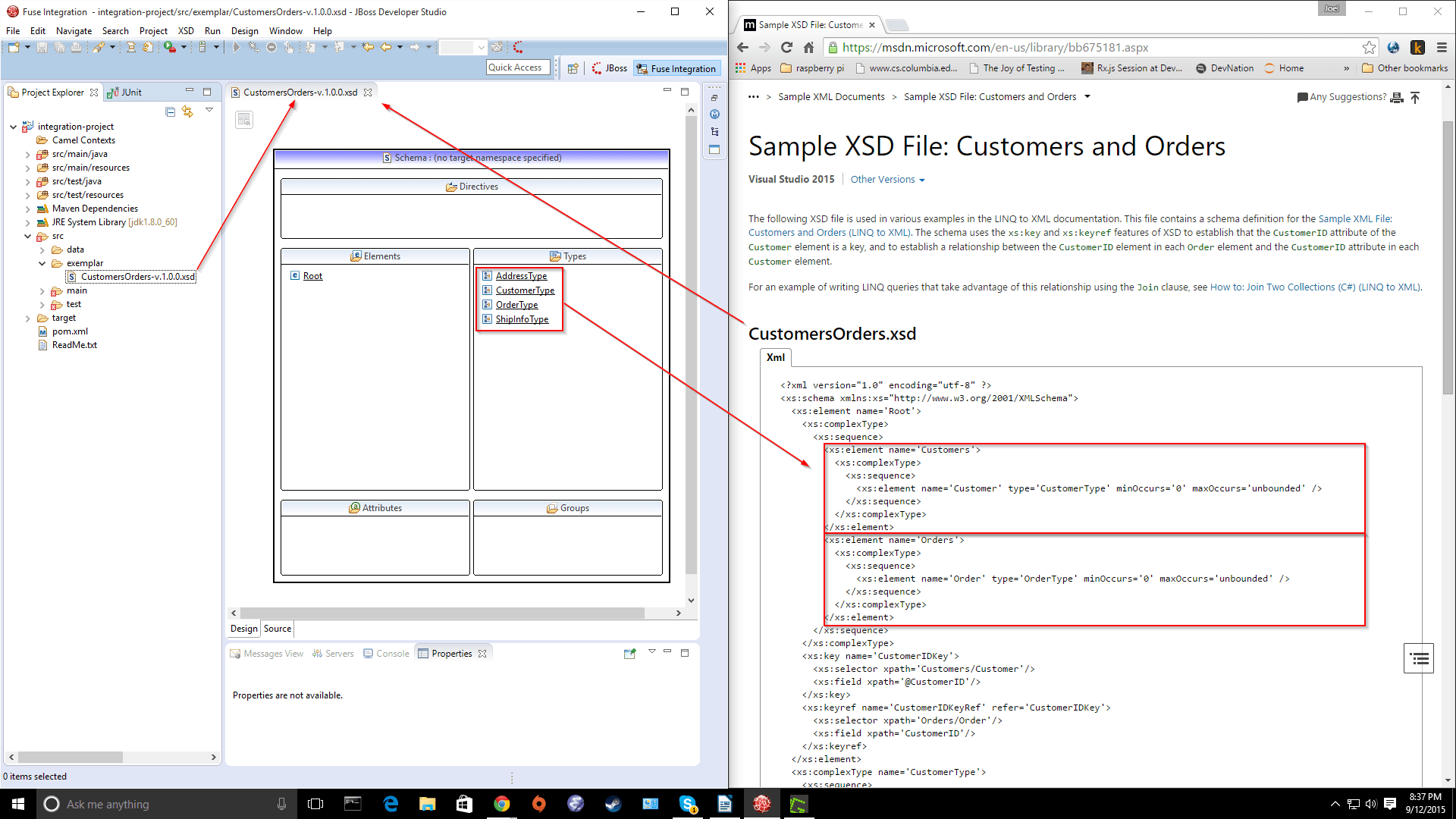
The XML schema defines the data contract used throughout the integration flow.
A maintainable integration project usually separates code by responsibility:
- Models represent schema-derived or API-derived data structures.
- Services contain focused domain or transformation behavior.
- Utilities provide reusable parsing, file, serialization, or assertion helpers.
- Routes express orchestration: input, processing steps, error policy, and output.
Tests should mirror this structure. That symmetry makes ownership obvious and keeps route tests from becoming the only place where behavior is verified.
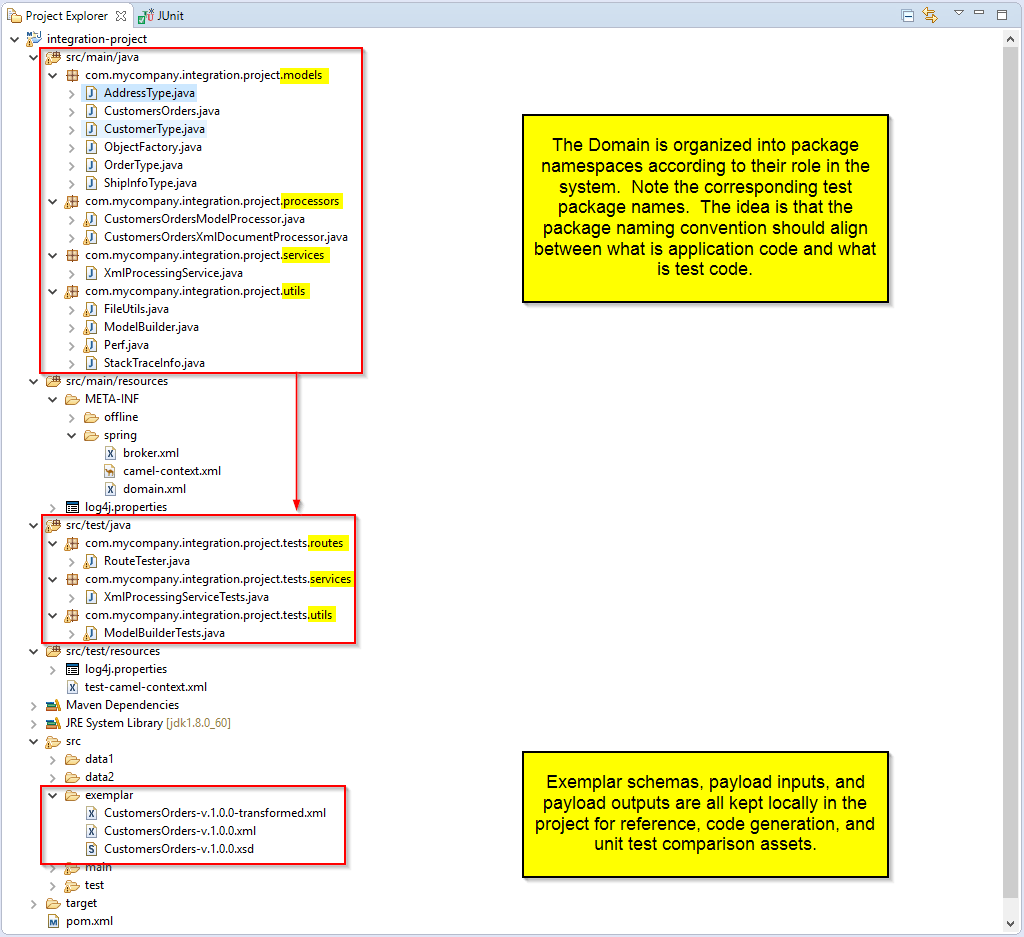
Production code and test code should follow the same responsibility boundaries.
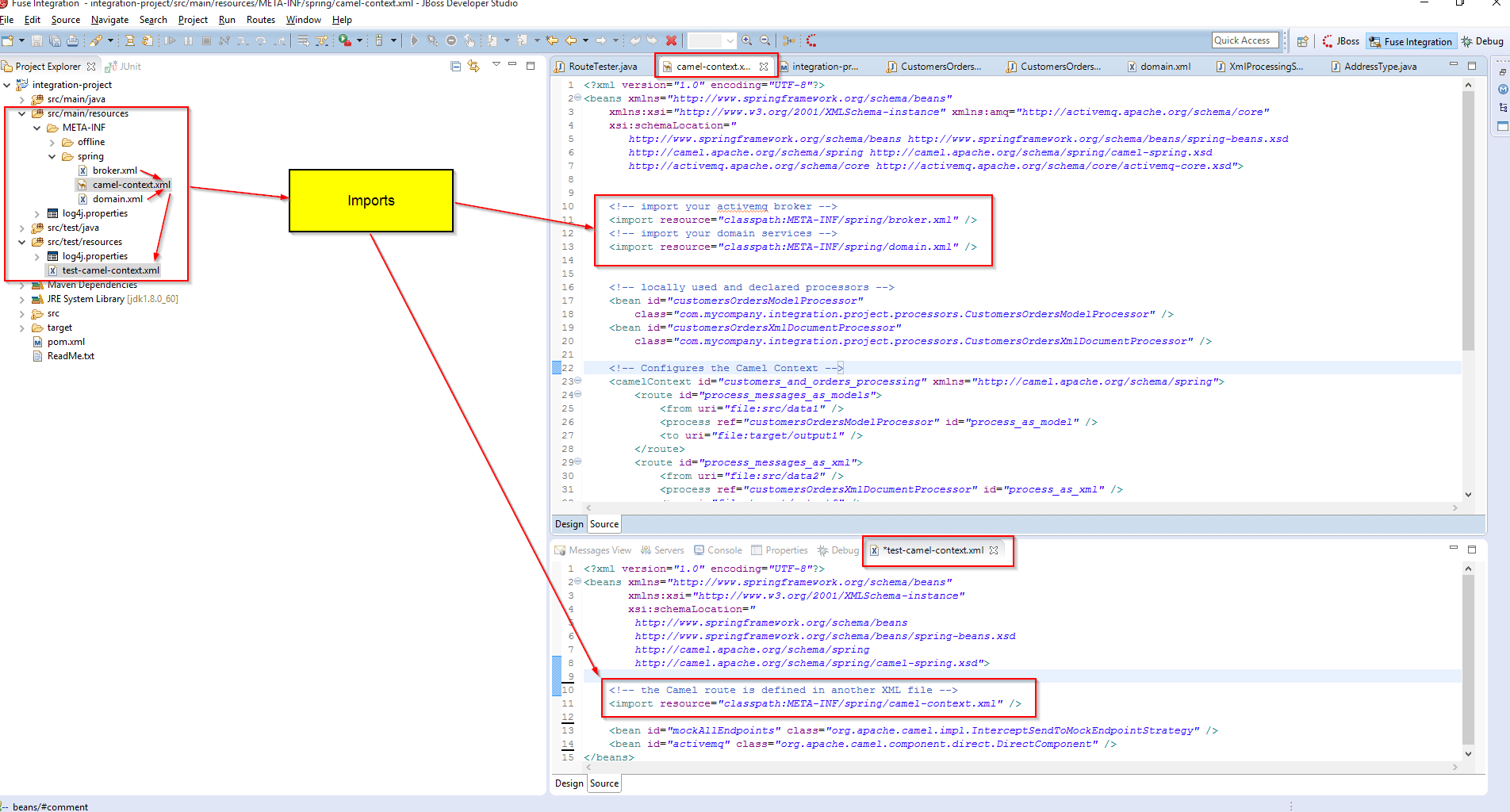
Spring context files can be organized by bounded context so tests import only what they need.
Test transformations with plain unit tests
Start with the parts that do not require Camel at all. XML deserialization, JSON mapping, enrichment, validation, idempotency key generation, and status mapping should have ordinary unit tests.
package com.mycompany.integration.project.tests.utils;

import org.junit.Test;

import com.mycompany.integration.project.models.CustomersOrders;
import com.mycompany.integration.project.utils.FileUtils;
import com.mycompany.integration.project.utils.ModelBuilder;

import static org.junit.Assert.assertNotNull;

public class ModelBuilderTests {

    private final String xmlFilePath =
        "src/exemplar/CustomersOrders-v.1.0.0.xml";

    @Test
    public void deserializes_customer_order_payload() throws Exception {
        String xml = FileUtils.getFileString(xmlFilePath);

        CustomersOrders payload = CustomersOrders.class.cast(
            ModelBuilder.deserialize(xml, CustomersOrders.class));

        assertNotNull(payload);
    }
}
These tests are cheap and specific. They should fail because transformation behavior changed, not because a broker is down or a port is already in use.
Test domain services with a narrow Spring context
When a service depends on Spring-managed collaborators, load the smallest context that gives the service its real dependencies. Keep the context narrow enough that the test still explains what behavior it owns.
package com.mycompany.integration.project.tests.services;

import org.junit.Test;
import org.junit.runner.RunWith;
import org.springframework.beans.factory.annotation.Autowired;
import org.springframework.test.annotation.DirtiesContext;
import org.springframework.test.context.ContextConfiguration;
import org.springframework.test.context.junit4.SpringJUnit4ClassRunner;

import com.mycompany.integration.project.services.XmlProcessingService;
import com.mycompany.integration.project.utils.FileUtils;

import static org.junit.Assert.assertNotNull;
import static org.junit.Assert.assertTrue;

@RunWith(SpringJUnit4ClassRunner.class)
@ContextConfiguration(locations = {
    "classpath:META-INF/spring/domain.xml"
})
@DirtiesContext(classMode = DirtiesContext.ClassMode.AFTER_EACH_TEST_METHOD)
public class XmlProcessingServiceTests {

    private final String xmlFilePath =
        "src/exemplar/CustomersOrders-v.1.0.0.xml";

    @Autowired
    private XmlProcessingService xmlProcessingService;

    @Test
    public void injects_service() {
        assertNotNull(xmlProcessingService);
    }

    @Test
    public void processes_an_xml_transaction() throws Exception {
        String xml = FileUtils.getFileString(xmlFilePath);

        Boolean result = xmlProcessingService.processTransaction(xml);

        assertTrue(result);
    }
}
This level verifies the Spring composition and the service behavior without making a route test responsible for every detail.
Test routes by replacing infrastructure
For a route test, the route is the system under test. The test should usually replace external infrastructure while preserving the route logic itself. In Camel, that often means importing the production route and swapping real endpoints for mock or direct endpoints.
<beans
    xmlns="http://www.springframework.org/schema/beans"
    xmlns:xsi="http://www.w3.org/2001/XMLSchema-instance"
    xsi:schemaLocation="
        http://www.springframework.org/schema/beans
        http://www.springframework.org/schema/beans/spring-beans.xsd
        http://camel.apache.org/schema/spring
        http://camel.apache.org/schema/spring/camel-spring.xsd">

    <import resource="classpath:META-INF/spring/camel-context.xml" />

    <bean
        id="mockAllEndpoints"
        class="org.apache.camel.impl.InterceptSendToMockEndpointStrategy" />

    <bean
        id="activemq"
        class="org.apache.camel.component.direct.DirectComponent" />

</beans>
That test context gives the route a real Camel runtime but avoids the cost and nondeterminism of a live broker. The result is still an integration test, but it is an integration test at the route boundary rather than at the entire environment boundary.
Example route under test
<camelContext
    id="customers_and_orders_processing"
    xmlns="http://camel.apache.org/schema/spring">

    <route id="process_messages_as_models">
        <from uri="file:src/data1" />
        <process
            ref="customersOrdersModelProcessor"
            id="process_as_model" />
        <to uri="file:target/output1" />
    </route>

    <route id="process_messages_as_xml">
        <from uri="file:src/data2" />
        <process
            ref="customersOrdersXmlDocumentProcessor"
            id="process_as_xml" />
        <to uri="file:target/output2" />
    </route>

    <route id="process_http_messages_as_xml">
        <from
            uri="jetty:http://0.0.0.0:8888/myapp/myservice/?sessionSupport=true" />
        <process
            ref="customersOrdersXmlDocumentProcessor"
            id="process_http_input_as_xml" />
        <to uri="file:target/output3" />
        <transform>
            <simple>OK</simple>
        </transform>
    </route>

</camelContext>
Route IDs should describe behavior, not implementation trivia. A route named process_http_messages_as_xml is easier to connect to a test failure than a route named route3. A useful convention is to align route IDs with test names or with the business behavior asserted by the test.
Mock endpoints, not the route
The most useful route tests keep the route real and mock the edges. In Camel, endpoint interception creates a predictable mock endpoint for each endpoint URI:
file:target/output1 becomes mock:file:target/output1
The test can then assert what the route emitted:
MockEndpoint output =
    getMockEndpoint("mock:file:target/output1");

output.expectedMessageCount(1);
output.expectedBodiesReceived(expectedPayload);
output.expectedHeaderReceived("status", "SUCCESS");

template.sendBody("direct:start", inputPayload);

assertMockEndpointsSatisfied();
Good assertions cover the contract, not incidental internals. Assert the body, headers, message count, destination, and error outcome. Avoid asserting every private implementation step unless the step is part of the contract.
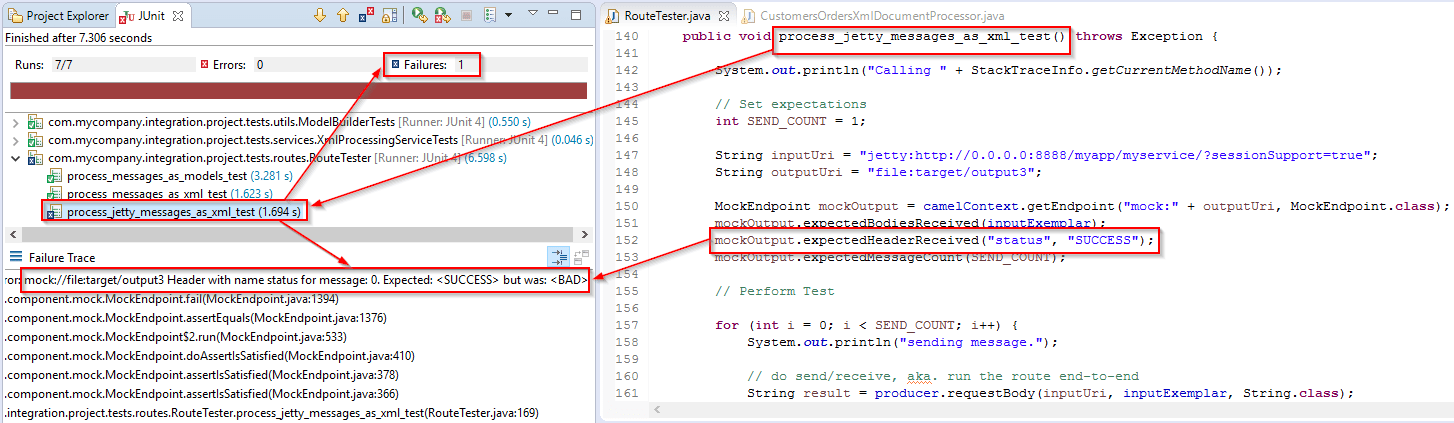
Expectation-driven failures are precise, which reduces debugging time.
Mock HTTP and vendor endpoints deliberately
Not every dependency is a Camel endpoint. Many routes call HTTP services, vendor APIs, identity providers, object stores, or internal microservices. Those dependencies need their own replacement strategy.
- Use WireMock, MockWebServer, or an equivalent local HTTP server when the route must exercise real HTTP serialization, headers, status codes, and timeouts.
- Use fake client implementations when the route calls a typed client and the HTTP details are already covered elsewhere.
- Use contract tests when both sides of the API need agreement on request and response shapes.
- Use a small number of live environment tests to verify credentials, DNS, TLS, IAM, broker topics, queues, and deployment wiring.
A local HTTP mock lets a test exercise real failure behavior without depending on the real service:
mockServer.stubFor(post(urlEqualTo("/orders"))
    .withHeader("Content-Type", containing("application/json"))
    .willReturn(aResponse()
        .withStatus(202)
        .withHeader("Content-Type", "application/json")
        .withBody("{\"status\":\"accepted\"}")));

template.sendBody("direct:submitOrder", orderJson);

mockServer.verify(postRequestedFor(urlEqualTo("/orders")));
This kind of test is especially valuable for retries, timeout handling, idempotency keys, authentication headers, and non-200 responses. Those are exactly the integration behaviors that tend to break late if they are only tested manually.
Test the error paths as first-class behavior
Happy-path route tests are necessary but insufficient. Integration code spends much of its life dealing with imperfect collaborators. Tests should cover the behavior you expect when dependencies fail.
- Malformed input should produce a clear rejection, dead-letter message, or validation error.
- Transient downstream failures should trigger the intended retry policy.
- Permanent downstream failures should stop retrying and preserve enough context for diagnosis.
- Duplicate messages should exercise idempotency behavior.
- Timeouts should be deterministic in tests, not dependent on sleeping threads for long periods.
If the route has an error handler, dead-letter channel, retry policy, or compensating action, treat that as product behavior and test it explicitly.
Keep the test pyramid honest
Integration-heavy systems still need a test pyramid. The shape is just different:
- Unit tests cover parsers, mappers, validators, status translation, and pure functions.
- Component tests cover Spring-managed services and processors with narrow application contexts.
- Route tests cover Camel orchestration with mocked endpoints and controlled collaborators.
- Contract tests verify API and message compatibility between producers and consumers.
- Environment tests verify the live wiring that cannot be proven in-process.
The mistake is pushing every concern into environment tests. Those tests are valuable, but they are slower, more expensive, and less precise. Route-level tests give fast feedback about behavior before deployment becomes the debugging tool.
What to avoid
- Do not hard-code production endpoint URIs directly into route logic when tests need to replace them.
- Do not test a mock of the route and then assume the real route works.
- Do not make every test depend on live queues, live vendor APIs, or shared databases.
- Do not assert only that “no exception was thrown.” Integration tests should assert bodies, headers, destinations, counts, and error outcomes.
- Do not ignore negative paths. Failed dependencies are part of the design surface.
Why this approach pays off
- Faster feedback: route failures surface while coding, not during deployment or manual QA.
- Safer change: route behavior is protected as schemas, endpoints, and collaborators evolve.
- Lower coupling: tests are not blocked by infrastructure availability.
- Better diagnostics: failed expectations identify the broken contract instead of reporting only that the workflow failed.
- Continuous confidence: CI can run route checks on every build.
These are not Camel-specific ideas. They are software design habits applied to integration architecture: isolate boundaries, name contracts, replace nondeterministic dependencies, and verify behavior continuously.
Conclusion
Testable routing is not mainly about test syntax. It is about the shape of the system. A route with explicit contracts, injectable collaborators, narrow processors, and mockable endpoints is easier to reason about and safer to change.
The practical rule is this: keep the route real, control the boundaries, and assert the contract. When integration code is treated as designed software instead of incidental glue, tests become a tool for architecture rather than a tax paid after implementation.
The original sample project is available here:
tags: BDD - DDD - integration - java - TDD