Automata Arcade Is Becoming an Instrument
by Joel Holder
Automata Arcade now has selection transforms, lenses, zones, and manifold-mapped regions. The project is shifting from a cellular automata sandbox into a small workbench for building, inspecting, and reusing emergent systems.
Automata Arcade started as a simple cellular automata canvas: paint cells, run the simulation, watch the pattern evolve.
That loop is still there, but the tool now supports the operations needed for serious iteration: select, transform, inspect, isolate, map, and reuse.
Try it here: Automata Arcade live demo · GitHub repository
The board is editable
Selection mode turns a region of cells into an object you can operate on. You can draw a rectangular selection, translate it, rotate it 90 degrees, flip it, copy it, cut it, paste it, and save the result as a prefab.
For cellular automata, that matters. A glider stream, oscillator, eater, failed collision, or partial circuit is no longer just transient state on the board. It becomes material.
The workflow changes from redrawing patterns by hand to editing mechanisms directly:
- observe a behavior
- select the active region
- transform or duplicate it
- test the new geometry
- save the useful result
That is the basic interaction model for an automata workbench.
Lenses keep local behavior readable
Lenses are circular magnifiers placed directly on the canvas. They enlarge a local region without zooming the whole board.
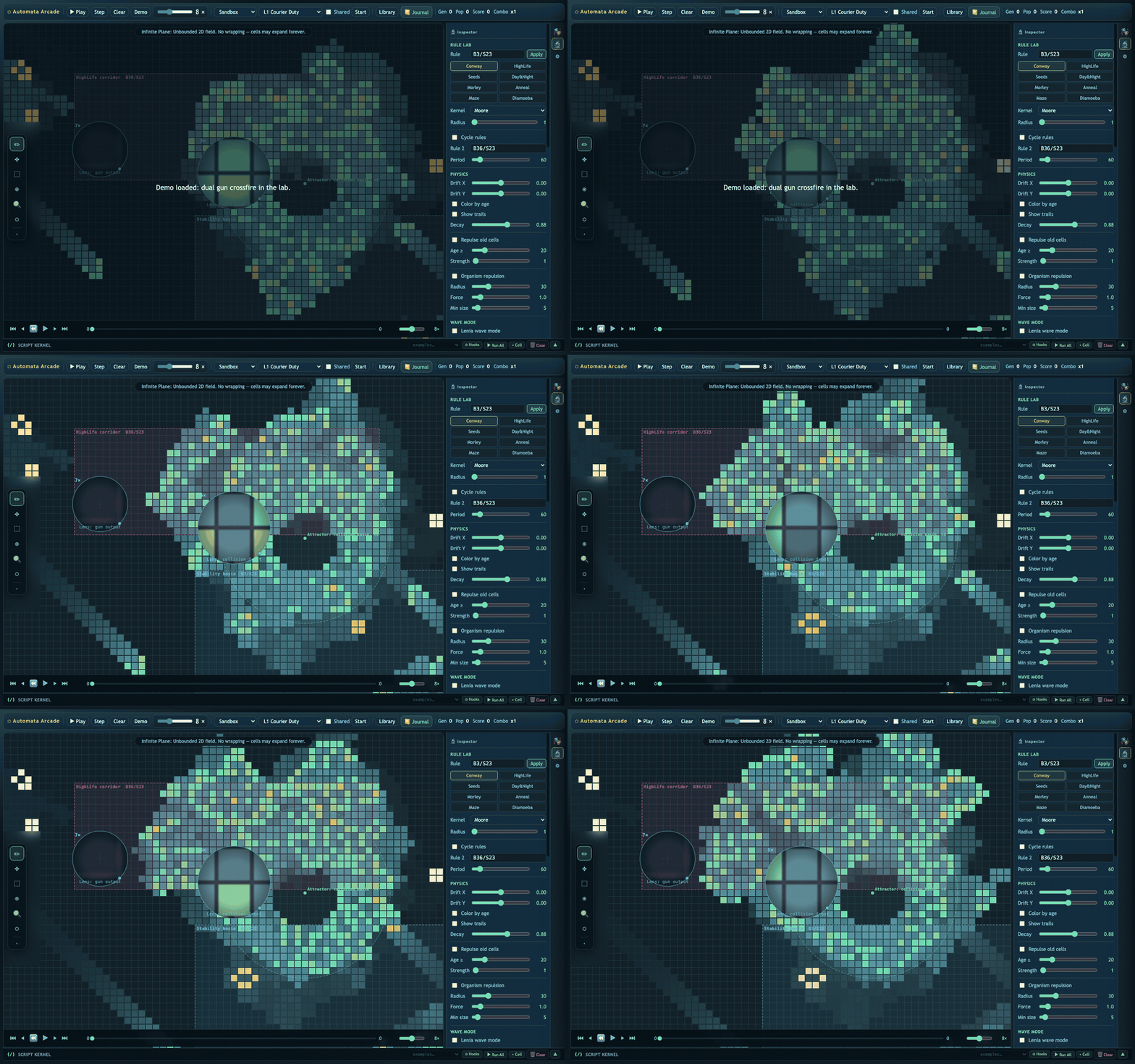
Automata are multiscale. You often need neighbor-level detail and board-level context at the same time: births, deaths, phase offsets, collision fronts, stream timing, boundaries, and population waves.
A normal zoom makes you choose between those views. Lenses let you keep both.
You can place one lens over a generator, another over a collision site, and compare cause and effect while the simulation runs.
Zones make rules spatial
Zones are rectangular regions with rule overrides. A cell can move from classic Life into HighLife, Seeds, Day & Night, or a custom B/S rule without leaving the board.
That makes the plane heterogeneous. A zone can act as a reaction chamber, protected basin, hostile boundary, rule-gradient experiment, or computational component.
The question becomes more precise: what happens when a structure crosses from one local physics into another?
That is useful for design, debugging, and play. It also gives rule changes a spatial form instead of treating them as global configuration.
Manifold regions make topology local
Manifold Regions map a rectangular patch of the flat board onto a topology such as a sphere, torus, Möbius strip, or Klein bottle.
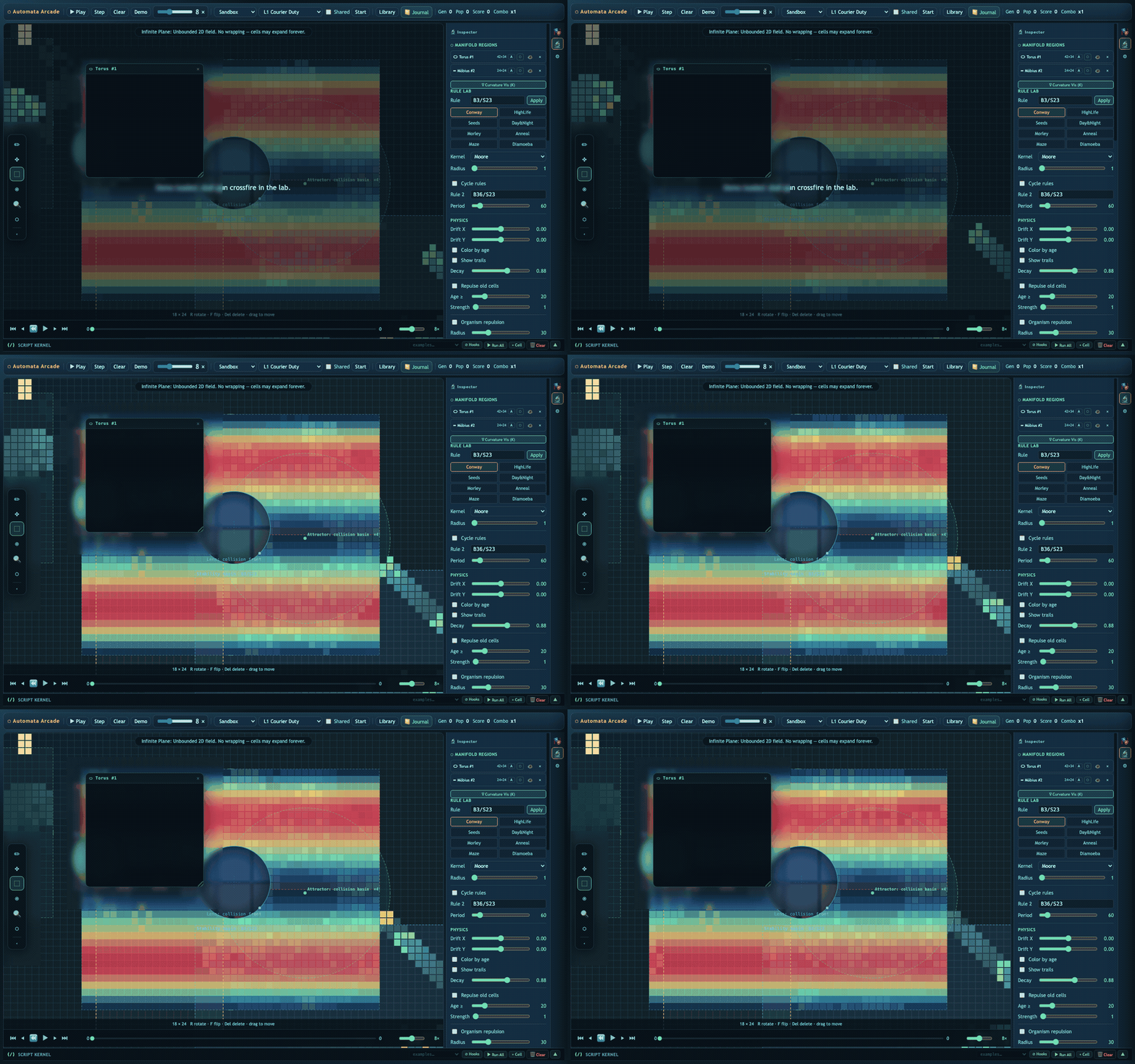
The whole board does not need to become a torus. A local patch can have toroidal adjacency while the surrounding workspace stays flat. Another patch can contain a Möbius seam.
This makes topology an editable part of the system. The same rule and seed can behave differently because the neighborhood graph changed.
For cellular automata, the rule is not the whole machine. Initial condition, observation, tools, and geometry all matter. Manifold Regions make the geometry explicit.
The IDE shape
Several systems are now converging:
- canvas tools: paint, select, transform, stamp
- analysis tools: period detection, population tracking, heatmaps
- rule tools: presets, B/S editing, kernel radius, Lenia controls
- spatial tools: zones, force fields, lenses
- topology tools: manifold regions and curvature visualization
- journal/script tools: documented, replayable experiments
The next useful step is persistence. Experiments should capture board state, rule configuration, selected regions, camera and lens positions, script cells, manifold mappings, and replayable timelines.
Prefabs should also become structured objects instead of screenshots: period, bounding box, velocity, input/output lanes, required phase, compatible rules, and known failure modes.
After that, topology can become a programming surface. Region seams, wraps, and local adjacency changes could be used as parts of spatial circuits.
The longer-term direction is an interactive atlas: scenes, rules, mechanisms, manifolds, and experiments that can be inspected, forked, mutated, and republished.
Automata Arcade is still an arcade. The play matters. But the current direction is clear: it is becoming an instrument for composing and studying cellular automata.
tags: Automata Arcade - cellular automata - creative coding - manifolds - simulation